Play Kismet Dice Game
The 1964 challenger - Colored dice, a Flush row and a graduated bonus.How to Play Kismet
In a nutshell: The 1964 challenger - Colored dice, a Flush row and a graduated bonus. You play with 5 dice and up to 3 rolls a turn across 15 scoring cells. It's rated medium, and a good game scores 300+; the color rows and sum-plus-premium scoring run totals high.
Kismet is the 1964 'deluxe' challenger to Yahtzee, instantly recognizable by its colored pips: 1s and 6s are black, 2s and 5s are red, 3s and 4s are green. Color creates categories no other family member has - the Flush (all five dice one color, 35 points) and the Full House Same Color (20 plus the dice). Most lower rows pay a premium on top of the dice sum: Full House is 15 plus the sum, Four of a Kind 25 plus, and the five-of-a-kind Kismet a mighty 50 plus. The upper section sports a graduated bonus - 35, 55 or 75 points as your total climbs from 63 through 71 to 78. The result is a lusher, higher-scoring, slightly flashier Yahtzee where the dice themselves are part of the puzzle.
Kismet at a glance
| Goal | Fill all fifteen categories, one per turn, for the highest total. Dice are colored: 1 & 6 black, 2 & 5 red, 3 & 4 green. |
|---|---|
| Dice | 5 six-sided dice, up to 3 rolls per turn |
| Categories | 15 |
| Difficulty | Medium |
| Good score | 300+ |
| Family | World Variants |
Step by step
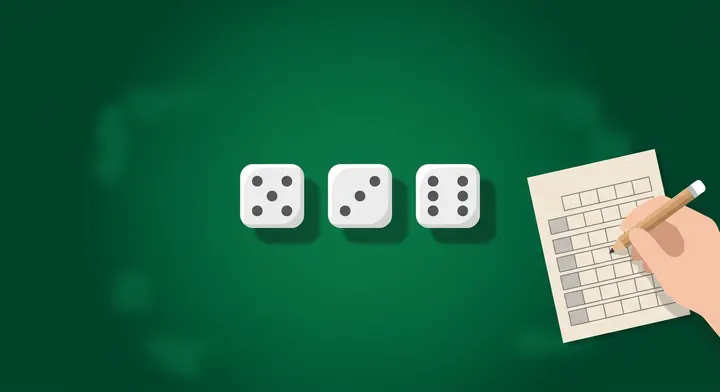
Goal
Fill all fifteen categories, one per turn, for the highest total. Dice are colored: 1 & 6 black, 2 & 5 red, 3 & 4 green.
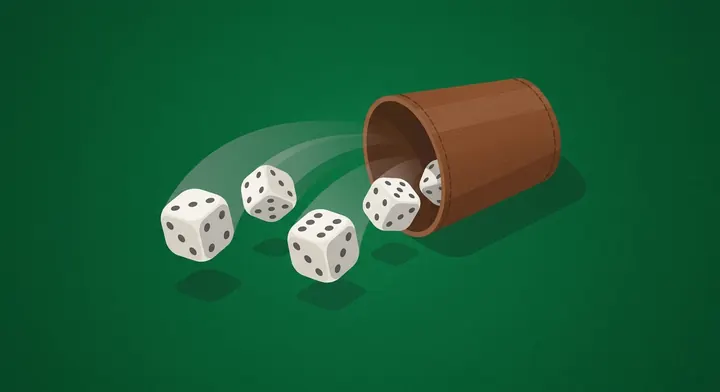
Rolling
Five dice, up to three rolls per turn, holding any dice between rolls.
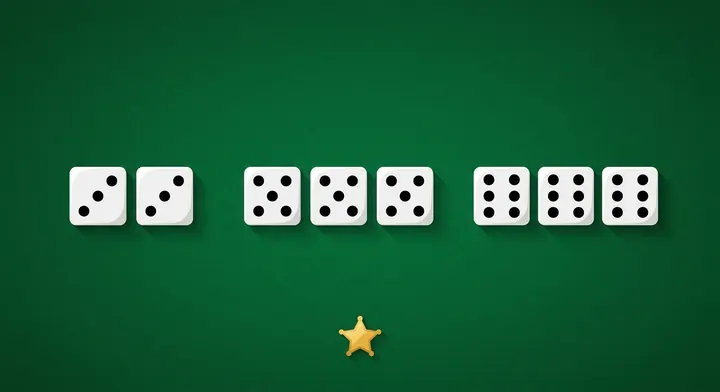
Upper section
Ones through Sixes score the sum of matching dice, with a graduated bonus: 35 points at 63-70, 55 at 71-77, and 75 at 78+.
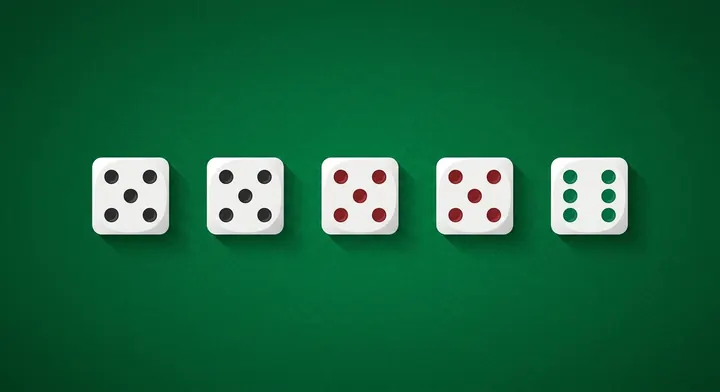
Color rows
Two Pairs Same Color needs both pairs matching their colors (sum of dice). Flush is all five dice in one color for 35. Full House Same Color - the triple and pair each color-matched - scores 20 plus the dice.
Premium combos
Full House is 15 plus the dice sum, Four of a Kind 25 plus, Straight (any five-run) a flat 30, Yarborough (chance) the plain sum, and Kismet - five of a kind - 50 plus the dice.
History of Kismet
Kismet was published in 1964 by Lakeside Industries as a direct, deluxe answer to Yahtzee's mid-60s boom. Its designers differentiated the game with one physical stroke - colored pips - and let the new dimension generate categories no plain-dice game could offer.
The graduated bonus and the premium-plus-sum scoring were equally deliberate: Kismet games end with bigger numbers, more late swings and a stronger comeback dynamic than its rival. Marketed as 'the modern game of yacht dice', it carved out a loyal audience without ever threatening the trademark giant.
Kismet has remained in continuous production for six decades - a cult classic whose colored dice still get mistaken for a gimmick right up until the first Flush lands for 35.
How to Win at Kismet: Strategy
💡 Top tip: The graduated bonus rewrites upper-section math: 78+ pays 75 points, so overloading Fives and Sixes pays double dividends.
Winning tips, in order of importance
- Remember the color pairings (1-6, 2-5, 3-4): a 2-2-5-5 hand is already four-fifths of a red Flush.
- Premium scoring makes high dice count twice - a 6-6-6-2-2 Full House scores 37, a 2-2-2-6-6 only 33... chase the big triple.
- The Flush (35 flat) is livelier than it looks: any three same-color dice after roll one make it a legitimate target.
- Kismet at 50-plus-sum (up to 80 points) is the family's richest five-of-a-kind - protect the row longer than you would in Yahtzee.
- Yarborough is Chance with a fancier name: bank your biggest homeless roll there, not your first mediocre one.
Advanced tactics for Kismet
- Color constraints halve the odds of the same-color rows versus their plain cousins - fill the plain Full House first and keep the color version for a served hand.
- The three bonus tiers create checkpoint play: crossing 71 mid-game justifies pure upper-chasing even at the cost of a lower-row zero.
- Since 1s and 6s share black, a junk 1 in hand still serves a black Flush draw - the colors quietly change which 'garbage' dice are worth holding.
- Sum-plus-premium rows mean late-game re-rolls for higher pips (not new combinations) are often correct - a made Four of a Kind of threes is worth improving.
Common Kismet mistakes to avoid
- Ignoring the color pairs - 1-6 black, 2-5 red, 3-4 green means a junk 1 can still be four-fifths of a black Flush.
- Stopping at the first bonus tier - 78+ upper points pays 75 instead of 35, so a hot upper section is worth pressing.
- Filling Full House Same Color first - it is twice as rare as the plain house, so score the easy version and keep the color row for a served hand.
- Re-rolling for new combinations instead of higher pips - most lower rows add the dice sum to a premium, so improving a made hand is real points.
Kismet Variations
Basic Kismet
House play that drops the color rows for a plain fifteen-row card.
Kismet 200
A shortened race format - first player past 200 wins.
Yahtzee hybrid
Kismet dice on a Yahtzee card, keeping the Flush as a fourteenth row.
Kismet FAQ
What is Kismet?
A 1964 commercial dice game - Yahtzee's flashiest rival - played with color-pipped dice (1 & 6 black, 2 & 5 red, 3 & 4 green) and a fifteen-row card featuring color-based categories and premium-plus-sum scoring.
How do the colored dice work?
Opposite faces share a color, so each die always shows one of the three colors. Color rows - Two Pairs Same Color, the Flush, Full House Same Color - require the combination's dice to match by color as well as number.
What is the graduated bonus?
The upper-section bonus scales with your total: 63-70 points pays 35, 71-77 pays 55, and 78 or more pays 75. It's the family's only bonus worth chasing past its threshold.
What is a Yarborough?
Kismet's name for Chance - the plain sum of your five dice. The name is borrowed from bridge, where it means a hand with nothing in it.
What does the Kismet row score?
Five of a kind pays 50 plus the sum of the dice - up to 80 for five sixes, the biggest single cell in the whole family.
What is a good Kismet score?
300+ is a good game and 400+ is strong - totals run higher than Yahtzee because most lower rows add a premium to the dice sum.
Is Kismet still sold?
Yes - it has stayed quietly in print since 1964, a favorite 'second game' for dice families. The name is Turkish-Arabic for fate, which is roughly what you'll be shouting at.
Still have a question about Kismet? Browse the full Yahtzee FAQ, look up a term in the Yahtzee glossary, print a score sheet for game night, or compare Kismet with the other games in the rules for every dice game.
Last updated .