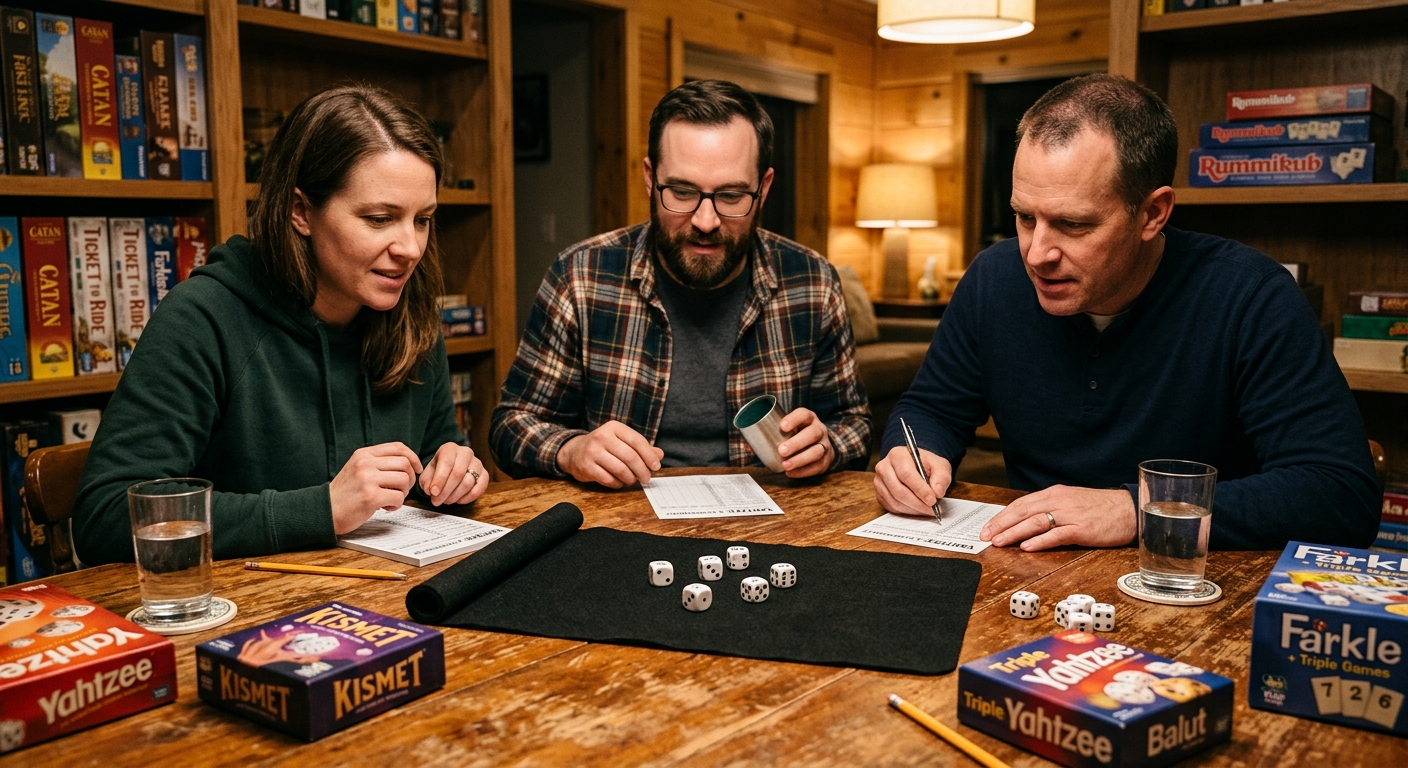
Yahtzee players often reach a point where one game per night stops being enough. The same five dice. The same thirteen categories. The same satisfying moment when five-of-a-kind lines up perfectly. But that appetite for more is exactly how you end up down a rabbit hole of regional variants, each one slightly different, each one scratching the same itch in a new way. The Yahtzee family is a global one, and its members are worth knowing.
What to Know Before You Branch Out
- Most Yahtzee relatives use five dice and three rolls per turn, so your core instincts transfer immediately.
- Games like Farkle add a push-your-luck layer that changes risk calculus in ways Yahtzee does not prepare you for.
- Regional variants such as Generala and Balut reward players who already understand category strategy from Yahtzee.
Why the Yahtzee Family Spans the Globe
Yahtzee was popularized in North America by Milton Bradley in 1956, but the concept of rolling dice into scoring categories predates it by decades. Games built on the same skeleton , roll, hold, reroll, score , emerged independently across Scandinavia, Latin America, and Southeast Asia. Each culture added its own twist. Some changed the dice count. Some introduced banking mechanics. Some added bonus points for completing categories on the very first roll. The result is a loose family of games with shared DNA and very different personalities.
What makes this family worth studying is transferability. The habits you have built in Yahtzee, reading which category to target, knowing when a good roll is good enough, understanding how the bonus threshold works, all carry into these other games. You will not start from zero. You will start from an advantage.
Yatzy, Yahtzee's Scandinavian Sibling
Yatzy is the oldest confirmed relative in this family. It originated in Scandinavia and predates the branded Yahtzee product by a comfortable margin. Tracing Yatzy's lineage through Scandinavian game records shows it spread widely across northern Europe before Yahtzee ever reached the shelves of American toy stores.
The mechanics are almost identical to Yahtzee. Five dice, three rolls per turn, a scoresheet with categories that look instantly familiar. The differences are subtle but real. In standard Yatzy, the Chance category is included just as in Yahtzee. The bonus threshold for the upper section sits at 63 points, which also matches. The key difference most players notice first is the naming. What Yahtzee calls a Yahtzee, Yatzy simply calls a Yatzy. What Yahtzee calls Three of a Kind, some Yatzy variants label Three Alike.
Strategically, Yatzy plays almost identically to its American cousin. If you have a confident Yahtzee strategy, you can sit down at a Yatzy game and feel at home within two turns. It is your entry point into the broader family, a gentle bridge between the familiar and the foreign.
Generala and the Thrill of the One-Roll Win
Generala is the Latin American branch of this family tree. It is popular across Argentina, Uruguay, and other Spanish-speaking countries, and it adds a mechanic that changes how you think about every single roll. In Generala, scoring a category on your very first roll earns extra points. A five-of-a-kind on the first roll, called Generala, scores higher than the same result achieved after three rolls.
This bonus system injects tension into the opening roll that Yahtzee simply does not have. In Yahtzee, your first roll is just setup. In Generala, your first roll might already be your best play. You have to evaluate immediately whether banking the result is smarter than pressing for more.
Generala also uses a fixed set of categories that differs slightly from Yahtzee's scoresheet. There is no Chance category in many traditional versions. The scoring for certain combinations works differently too. This means the category-management instincts you carry from Yahtzee still apply, but you will need to recalibrate the specific numbers you are targeting.
What Yahtzee fans tend to love about Generala is the aggression it rewards. This is a game that celebrates bold play. A careful, defensive player will score respectably. A player willing to take the one-roll gamble at the right moment will score significantly higher.
Farkle and the Art of Knowing When to Stop
Farkle is where the Yahtzee family tree takes its most dramatic turn. It uses six dice instead of five. It has no scoresheet of categories. And it introduces the central mechanic that defines the entire experience: you can keep rolling as long as you score something, but the moment you roll and score nothing, you lose every point you built that turn.
Points in Farkle come from specific combinations. A single 1 scores 100 points. A single 5 scores 50. Three of a kind scores based on the face value. Six dice showing all different numbers, a straight, clears the table and lets you start rolling fresh. After each roll, you set aside at least one scoring die and decide whether to bank your running total or press your luck with the remaining dice.
This push-your-luck mechanic is what separates Farkle from every other game in this family. The question is never "which category do I fill?" The question is always "is what I have now worth more than what I might lose?" That shift in framing changes the entire mood of the game. Yahtzee rewards patience and category management. Farkle rewards reading risk in real time. Players who love the calculation side of Yahtzee will find that choosing to play farkle in the browser is a fast, low-stakes way to build that instinct without committing to a full table session.
The social element of Farkle is also worth mentioning. Because other players watch you roll, groan when you press too far, and cheer when you bust spectacularly, the game has a live audience energy that Yahtzee's turn-by-turn structure does not quite replicate. If you play Yahtzee with a group that loves table drama, Farkle fits that room perfectly.
Balut and the Category Game with Deeper Roots
Balut is a dice game that became especially popular in the Philippines and spread significantly through military communities across Southeast Asia. It uses five dice and three rolls per turn, placing it structurally close to Yahtzee. Its scoresheet, though, is quite different, and that difference is where the game earns its reputation for demanding sharper decision-making over a full session.
In Balut, you fill categories over multiple rounds, and the game requires you to score in every category a set number of times. The categories include Fours, Full House, Choice, Straight, and Balut, which is five-of-a-kind. The scoring for Fours is a running tally of all 4s rolled across those rounds, which creates a unique incentive structure. In Yahtzee, you want fours only when filling the upper section. In Balut, accumulating fours across multiple turns becomes a strategic priority that runs quietly in the background of everything else you do.
Yahtzee players tend to appreciate Balut for its density. More decisions per game. More interplay between categories. More situations where doing well in one area reshapes your priorities elsewhere. If you have ever finished a Yahtzee game wishing the scoresheet had been longer, Balut answers that directly.
Maxi Yatzy for Players Who Want More of Everything
Maxi Yatzy is an extended version of Yatzy that replaces the five-dice setup with six dice and adds more categories to the scoresheet. It originated in Scandinavia as a larger, longer variant designed for players who wanted a session with more depth and more possible outcomes per turn.
The six-dice format opens up combinations that simply do not exist in Yahtzee. A full house can involve more dice. Straights become longer. And six-of-a-kind joins the category list as the pinnacle achievement. The upper section expands to include 6s as a scoring category, and the bonus threshold adjusts accordingly.
For Yahtzee players, Maxi Yatzy is the most natural next step. The learning curve is small. The categories are familiar. The added complexity comes from having more options each turn, not from learning entirely new mechanics. It rewards the same instincts, just stretched further.
How These Games Compare Across Key Dimensions
| Game | Dice Count | Push-Your-Luck | Scoring Style | Best For |
|---|---|---|---|---|
| Yahtzee | 5 | No | Fixed 13-category sheet | Category strategy fans |
| Yatzy | 5 | No | Nearly identical to Yahtzee | Players wanting familiarity |
| Generala | 5 | Partial (first-roll bonus) | Categories with speed bonuses | Aggressive, bold players |
| Farkle | 6 | Yes, fully | Running total, bank-or-bust | Social, thrill-seeking groups |
| Balut | 5 | No | Multi-round category accumulation | Players wanting more depth |
| Maxi Yatzy | 6 | No | Expanded category sheet | Players who want Yahtzee, bigger |
Picking Your Perfect Match from the Dice Game Family
The cleanest way to choose your next game is to identify which part of Yahtzee gives you the most satisfaction, then follow that thread.
If you love category management, the careful decision of where to assign each turn's result, start with Yatzy. The experience is close enough to feel comfortable but different enough to stay interesting. From there, move to Balut when you want that same decision-making stretched across a longer, denser game with more categories competing for your attention.
If you love the moments when everything lines up on the first roll, that instant when you shake the dice and the result is already perfect, Generala is built for you. It takes that feeling and rewards it directly, turning first-roll fortune into first-roll bonus points that separate good games from great ones.
If you love the tension of Yahtzee but want more of it, more uncertainty, more moments where the right call is genuinely unclear, Farkle is the answer. The push-your-luck mechanic creates a kind of pressure that Yahtzee hints at but never fully commits to. The stakes feel different when a bad roll wipes out your entire turn rather than just forcing you into a zero on a category.
If you simply want more Yahtzee, a longer session, more categories, more combinations to aim for, Maxi Yatzy does exactly that without asking you to learn anything fundamentally new. It is the same game, given room to breathe.
The Yahtzee family rewards players who pay attention to patterns and probability. Every game in this list sharpens those same instincts in a slightly different environment. Starting with one means the others will feel more natural when you get to them. That is perhaps the best argument for playing all of them eventually. The dice are the same. The thinking gets better every time.